Battery Cell Selection

Key parameters for application-specific lithium-ion cell selection: energy and power density, safety, lifetime, cost, C-rate and impact on system design.
Selecting the right lithium-ion battery (LIB) cell for a specific application is a challenge and a frequent topic of debate in the industry. This article outlines the key evaluation parameters for application-specific cell selection and their impact on system design and performance.
The selection must consider application-specific requirements and constraints, such as the required charge and discharge C-rate, energy, lifetime, safety, energy and power density (gravimetric and volumetric) and cost ($/kWh). Cell characterization also plays a crucial role in ensuring the safety and reliability of the final product.
First, the requirements of each application must be clearly distinguished. Electric vehicles (EVs) require high energy density for an extended driving range, and fast-charging capability (high charging power) is essential. In stationary applications, fast charging is not a priority. Instead, cells must meet use-case-specific requirements such as long discharge durations and extended lifetimes, typically more than 10,000 cycles and/or 20 years.
1. Energy and power density
The Ragone plot, introduced by David V. Ragone in 1968, is one of the best-known methods for giving a rough idea of the energy and power density of different energy storage technologies. However, it is mainly a visualization tool and does not show other key parameters such as cost or lifetime. A more comprehensive methodology is therefore required, one that reflects the trade-offs between these parameters across different cell chemistries and formats.
Figure 1 shows a Ragone plot for LIBs of different chemistries, based on a database of approximately 700 cells. The values are approximate mean values and are intended only to illustrate general trends.

Fig. 1: Ragone plot of different LIB chemistries and formats
Based on Figure 1, the following observations can be made:
LIBs with lithium titanate oxide (LTO) anodes show the highest power density of all chemistries, but a lower energy density.
LIBs with nickel manganese cobalt oxide (NMC) and nickel cobalt aluminium oxide (NCA) cathodes show the highest energy densities. The small variance for NCA may be due to the relatively small number of NCA-based cells in the database.
Lithium iron phosphate (LFP) cells are predominantly manufactured by Chinese companies, while Japanese, European and American companies are key producers of LTO and NMC cells.
The volumetric energy density describes the energy stored per unit of volume, the gravimetric energy density the energy stored per unit of mass. Gravimetric energy density (GED) and gravimetric power density (GPD) are calculated as follows:
Eq. 1: GED [Wh/kg] = Vnom [V] × Capacity [Ah] / m [kg]
Eq. 2: GPD [W/kg] = Vnom [V] × Idch [A] / m [kg]
The resulting values depend on the definitions used and on the test conditions, such as the voltage range and the current rate applied during testing. The volumetric energy and power density are determined using the cell volume instead of its mass.
2. Safety
Safety must not be neglected: depending on the application, a battery failure can cause direct harm to people. The safety level of LIBs is often classified using the EUCAR hazard levels (HL), ranging from 0 to 7. The lowest level (HL 0) means no effect, the highest level (HL 7) refers to an explosion (Table 1). In general, a cell is considered safe if the hazard level stays below 4.
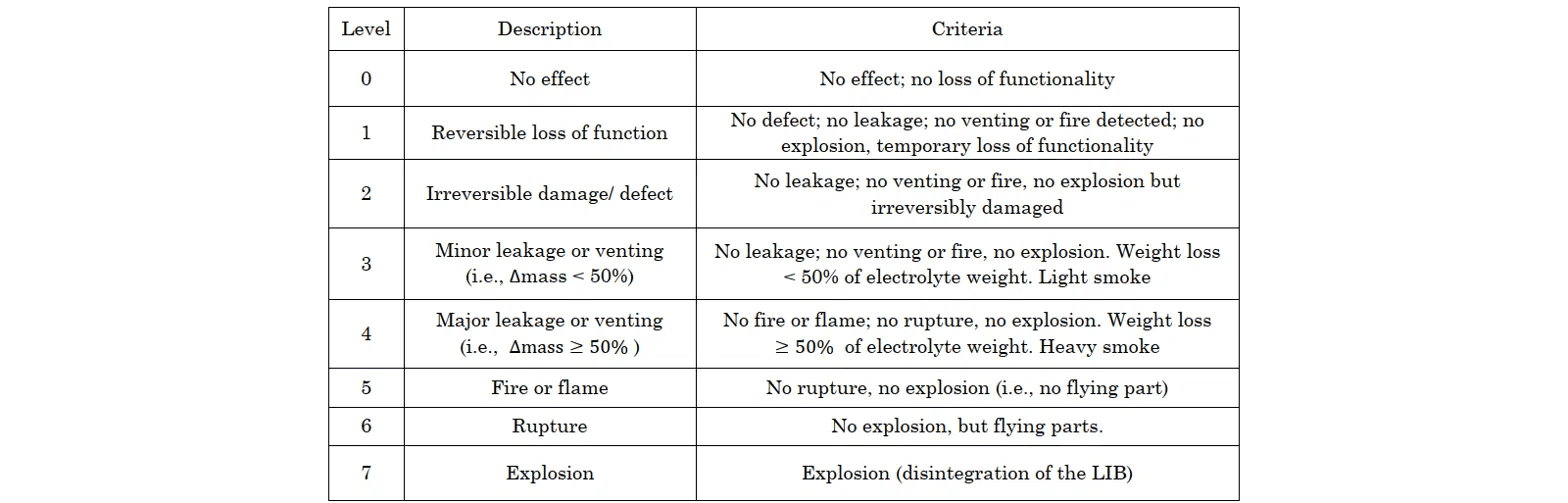
Table 1: Hazard levels according to EUCAR
Safety measures in a lithium-ion battery pack with a battery management system (BMS) can be divided into internal and external methods. External methods mainly rely on hardware that protects the pack against abuse conditions, for example cell bypass techniques in which the weakest cell is temporarily or permanently bypassed. Fuses and contactors protect the battery system against short circuits, overcharging and overdischarging.
3. Lifetime
Many factors influence the lifetime of LIBs. More fundamentally, it must first be defined what "lifetime" means. Two types are distinguished: cycle lifetime and calendar lifetime. The requirements depend on the application and its specific use case.
Cycle lifetime is assessed based on energy throughput. In EVs, for example, an energy throughput of 20–25 MWh is often expected before the battery reaches 80 % state of health (SOH). At the same time, the calendar lifetime of the battery system is typically projected at 15–20 years. The warranty provided for the battery often corresponds to the expected lifetime of the vehicle or system in which it is used.
4. Cost
The cost of battery cells and systems is typically expressed in dollars per kilowatt-hour ($/kWh). In recent years, a significant price reduction has enabled new battery-powered products in both mobile and stationary applications, exceeding even the most optimistic forecasts. A key observation: the higher the volumetric energy density of a cell, the lower its cost tends to be.
The cell itself remains the main cost driver of a battery system compared to other components. Cell costs are expected to decline faster than those of other system components such as cooling, power electronics and the BMS. Cost at cell or system level is calculated as follows:
Eq. 3: Cost [$/kWh] = Total cost of cell or system [$] / Energy content of cell or system [kWh]
5. Current and power capability
LIBs with LTO anodes are known for their excellent charge and discharge capability, which makes them well suited for applications requiring high charging power. They also offer longer lifetimes than other chemistries, but at a higher cost. The maximum charge and discharge capability is expressed as the C-rate:
Eq. 4: C-ratedch [1/h] = Imax,dch [A] / Capacitydch [Ah]
Eq. 5: C-ratech [1/h] = Imax,ch [A] / Capacitych [Ah]
Fast charging can put considerable stress on battery ageing and safety, mainly due to lithium plating. It also affects the thermal management system, can lead to overheating and may reduce the overall lifetime of the cell. The desire for fast charging must therefore be balanced against these risks.
Figure 2 shows the discharge power-to-energy ratio of cells of different chemistries and formats from the database. The cells cover a wide range of power and energy capabilities, with a clear emphasis on high-power cells.

Fig. 2: Discharge power-to-energy ratio of different LIB chemistries and formats
6. Impact on system design
When designing a battery system, it is critical to consider not only the charging current capability and the associated thermal management, but also the physical characteristics of the cells in relation to the entire module or system:
Cell volume to module/system volume ratio [%]
Cell weight to module/system weight ratio [%]
These ratios directly influence the volumetric and gravimetric energy density of the battery system. Higher ratios mean that a larger share of the system's volume and weight is dedicated to energy storage, which generally leads to higher system energy density. This is particularly important where space and weight are at a premium, such as in EVs. The ratios should be maximized within the constraints of safety, durability and cost.
Summary
Selecting lithium-ion cells for a specific application means balancing several key parameters:
Long cycle life: the ability to withstand a large number of charge and discharge cycles without significant degradation.
Low cost: economic feasibility in relation to performance and lifetime.
High energy density: the amount of energy stored in a given volume or mass, crucial where long operation between charges is required.
High power density: the ability to deliver high power quickly, important for applications with high power demand.
High energy density and high power density are typically a trade-off: optimizing a cell for one usually means compromising on the other. The requirements of the specific use case therefore determine how these parameters are prioritized.
Looking for the right cell for your application? Our cell selection and benchmarking is based on an independent database of cells across all common chemistries and formats. Talk to an expert.